25 Years of Mutter – Feature
Rammstein – Mutter: The Aesthetics of Brutality
Twenty-five years ago, Rammstein released an album that fused industrial metal with orchestral grandeur, turned a boxer’s walkout track into a Snow White epic, and transformed the band from a German curiosity into an international force. Mutter wasn’t just their third album. It was the test of whether Rammstein were more than fire and provocation.
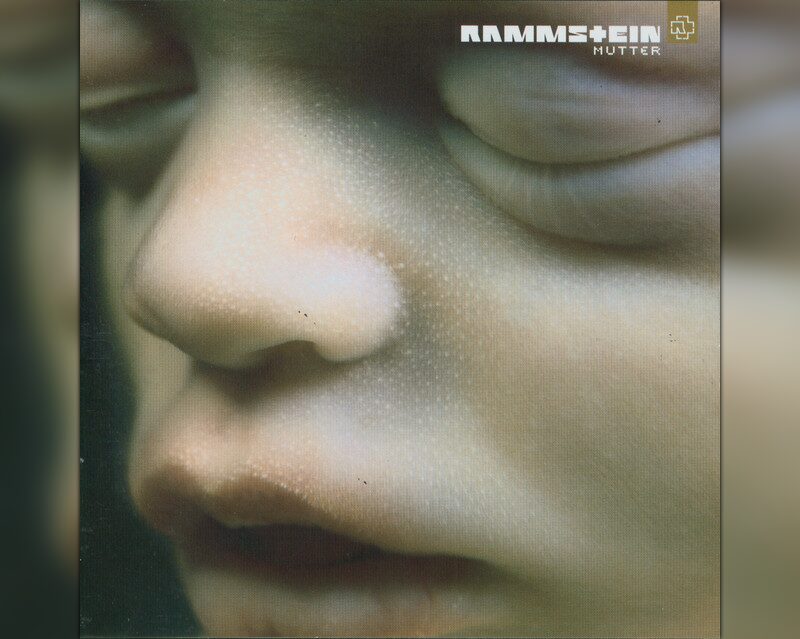
A fetus stares from the album sleeve. The girl was stillborn more than two hundred years ago, preserved in formaldehyde, photographed by Daniel and Geo Fuchs for their series Conserving. Germany’s tabloid BILD raged, the Catholic Church protested, and Rammstein had achieved – before a single note was heard – precisely what this album negotiates at its core: a confrontation you cannot ignore.
Mutter was released on 2 April 2001, Rammstein’s third studio album after Herzeleid (1995) and Sehnsucht (1997). It debuted at number one in Germany, Austria and Switzerland, held the top spot in Germany for four weeks, and charted in 17 countries – from number 2 in Sweden to number 77 in the US. Six singles, triple Platinum in Germany, over 1.4 million units sold worldwide. The numbers tell a story of breakthrough. But they don’t tell you why this album sounds the way it does.
Heiligendamm: Where the Hardness Softened
In September 1999, six men moved into a derelict house on the Baltic Sea. Haus Weimar in Heiligendamm, once a retreat for East German political elites, had no functioning kitchen, no toilets, no furniture. The band bought everything themselves, hired a cook and got to work. Over four months, cut off from Berlin, the skeleton of thirteen songs took shape.
The process was designed to be democratic – and that’s exactly what made it a problem. Drummer Christoph Schneider later described the tensions to Louder Sound: “Richard tried to lead the band…He was trying to control everything.” Guitarist Richard Kruspe attempted to seize control of the collective writing process. The band came close to splitting.
They didn’t split. Instead, they developed a working method that would define Mutter: Till Lindemann wrote lyrics, Paul Landers evaluated them, usable drafts went up on the wall. What survived had to withstand all six. What fell, fell without mercy.
Miraval: The Sound Between Stone and Steel
In May 2000, the band relocated to Studio Miraval in Correns, southern France. Telefunken U47, Neumann M149, Mesa Boogie Dual Rectifier – the technical inventory read like a wish list for audio purists. Producer Jacob Hellner, who had already helmed Herzeleid and Sehnsucht, pursued a clear division: no interference in songwriting, total control in the studio.
The band described Hellner’s method as disciplined to the point of obsession. After a day in the studio, the musicians said, he would sway as if drunk – not from alcohol, but from concentration.
The decisive break from the predecessors came through the Deutsches Filmorchester Babelsberg, conducted by Günter Joseck. For the first time, a Rammstein record deployed orchestral elements – not as garnish, but as a load-bearing foundation. Hellner on the subject: “I’ve always had a soft spot for when they did that kind of drama, which was possible in the slower and mid-tempo stuff – there was more space to really go into those colours.”
The first session with the orchestra, however, turned into a catastrophe. The commissioned arranger had altered the compositions without authorisation. Hellner recalled: “We had this enormously expensive orchestra come into this enormously expensive studio…when they started to play the music, it just sounded strange. Really awkward.” The orchestra had to return the following day for a complete retransposition. String arrangements were ultimately handled by Olsen Involtini.
The mixing process wasn’t smooth either. Six weeks of work with mixing engineer Ronald Prent at Sweden’s Galaxy Studios ended in dissatisfaction. It was Stefan Glaumann, taking over in October 2000 at MVG Studios in Stockholm, who found the sound the band had been searching for – at a rate of five days per track with two days’ rest in between. Howie Weinberg mastered the album at Masterdisk Corporation in New York.
The Anatomy of the Singles
Mutter spawned six singles – more than any other Rammstein album. Each one tells a story that extends beyond the song itself.
“Sonne”: From the Boxing Ring to the Fairy Tale
The first single arrived on 12 February 2001, and its origin story ranks among the best anecdotes in the band’s history. Someone burst into the rehearsal room shouting: “Klitschko needs a song!” Ukrainian boxer Vitali Klitschko was looking for entrance music. Paul Landers recounted that the band tried to move like a boxer while writing, to nail the right tempo. The song was finished in two days.
Klitschko never used it. He lost his fight beforehand – and found the song “a bit too hard” anyway.
What began as a boxer’s anthem became a Snow White epic. Bassist Oliver Riedel had cut the song together with scenes from the Disney film, and the band recognised: it fits. They had previously rejected around forty video concepts. The final version shows the band as dwarves mining gold for a gold-addicted Snow White – played by Yulia Stepanova.
“Sonne” reached number 2 in Germany, number 5 in Austria, number 6 in Spain. In Germany, the single was certified triple Gold – 900,000 units sold. A piece of entrance music for a boxer who never used it sold close to a million copies.
“Links 2-3-4”: The Heart Beats Left
On 14 May 2001, Rammstein answered a question that had been lingering since their 1998 “Stripped” video. That clip had used footage from Leni Riefenstahl’s Olympia (1938) – an aesthetic gambit that earned them accusations of far-right sympathies. “Links 2-3-4” was the response, and it left no room for ambiguity.
The title quotes a military marching count, deliberately using the archaic German “zwo” instead of “zwei” for “two.” The lyric “Mein Herz schlägt links” – “my heart beats left” – works on two levels: anatomically accurate and politically unequivocal. A reference to the Einheitsfrontlied, a 1930s revolutionary workers’ song, underscores the positioning. Thorsten Zahn, then editor-in-chief of Metal Hammer Germany, contextualised the impact for German audiences: the double meaning of “links” – directional instruction and political allegiance – gives the song a resonance in Germany that it can’t fully carry elsewhere.
The music video deployed CGI: ants representing the left battle beetles symbolising Nazis. In December 2000, the band had already made the song available for download on their website. In the charts, it reached number 15 in Finland, number 26 in Germany, number 33 in Austria.
“Ich will”: The Bank Heist Before the State of Emergency
The third single was released on 10 September 2001. One day later, two planes flew into the World Trade Center.
The music video – shot in the former Staatsratsgebäude, the East German State Council building in Berlin, premiered on 27 August – shows the band staging a bank robbery. Flake wears a bomb strapped to his body. At the end, the band receives a Goldene Kamera award on the red carpet, dressed in prison uniforms. The band described the concept as a reckoning with the media’s obsession with crime and the immortality that perpetrators gain through coverage.
The timing was devastating. The single’s promotion vanished in the shadow of September 11. Still, “Ich will” reached number 19 in Finland and Spain, number 29 in Germany, number 30 in the UK. In Germany, the song was certified Gold at 250,000 units.
The Late Singles
“Mutter” followed on 25 March 2002, “Feuer frei!” on 14 October of the same year. The latter gained a reach no music video alone could have generated through its placement in the opening scene of the Vin Diesel blockbuster xXx. The sixth single, “Mein Herz brennt”, didn’t arrive until 7 December 2012 – eleven years after the album, as though the record still had something left to deliver.
The Tour: Birth as Spectacle
The Mutter tour comprised over a hundred shows between May 2001 and July 2002. In most territories, the band jumped from theatres to arenas. Production designer LeRoy Bennett staged a set that translated the album’s themes into the physical. Lifeless tiles resembling East German delivery rooms. Keyboardist Flake perched on a converted dentist’s chair in a white coat with a blood bag pinned to it. And descending from the ceiling, a massive, red, pulsating uterus.
The band entered the stage through a birth canal – wearing nappies. Bennett explained the construction: “The birthing canal they were coming out of was a tube that was used for escaping out of a fire, and it had fireproof webbing on the inside.” Clawfinger keyboardist Jocke Skog, who opened on the tour, reported on the band’s priorities: “They told us, ‘We’ve put 80% of all the money we make back into this tour.'”
In the UK, the first London show at the Astoria was postponed by the authorities on safety grounds – the band moved to the larger Brixton Academy instead. In 2002, they headlined the 15,000-capacity Docklands Arena, despite Mutter reaching only number 86 on the UK chart. PR agent Anna Maslowicz, who encouraged the band to conduct interviews in English despite their limited command of the language, summed it up: “After that first media run, they never looked back…The UK embraced them.”
The Fracture
The US tour in autumn 2002, supporting Slipknot and System of a Down, ended early. Richard Kruspe had been in New York on 11 September 2001 and witnessed the second plane hit. Flake left the tour due to anxiety. In the 2015 documentary Rammstein in Amerika, he said: “We totally slipped into this wave of hysteria, and I found the frenzied atmosphere very frightening.”
The band didn’t return to North America for nine years. For a band that had just achieved its international breakthrough, that was a rupture no chart position can measure.
The Third Album Problem
Jacob Hellner put it plainly: “Your third album would define whether you were there to stay or just a flash in the pan…They realised that, and even though they’d had massive hits with Sehnsucht, they still had the bravery to follow their artistic instinct and go where they went.”
Thorsten Zahn recalled the pre-release nerves: “Everyone was nervous that the third record would turn out bad.” It didn’t turn out bad. It turned out to be the album that defined Rammstein’s position – not as a novelty act with pyrotechnics, but as a band capable of merging orchestral pathos with mechanical force without either diminishing the other.
The album title itself contributed. Zahn: “A record called Mutter – ‘mother’ – is a pretty strong expression. Most people have a very special relationship to their own mother, and if you like this band and the sound they put on a record called Mutter, all of a sudden you have a special relationship to this record.”
Winston McCall of Parkway Drive articulated the musical impact: “Every chorus is literally, like, a line…Everything about it is made to get into your brain, and it’s pounded in there by riffs that are fucking relentless.” On the opener “Mein Herz brennt”, he said: “The grandness straight-up, the strings coming in straight away, then the female vocalisations…tying it with that whole Mutter theme – it’s fucking genius.”
Peter Tägtgren, producer and driving force behind Hypocrisy, recommended Mutter as reference material for aspiring producers: “orchestra parts, heavy guitars, good drum sound.”
What Remained
Twenty-five years on, Mutter is the album Rammstein must measure themselves against. Not Sehnsucht with its “Du Hast” momentum, not the self-titled album of 2019 with its stadium anthems. Mutter was the moment the band proved that behind the provocation stands a musical architecture that holds.
The orchestral sessions in Berlin, the failed mixing attempts in Sweden, the four months in an empty house on the Baltic Sea – all of it speaks of a band willing to take the uncomfortable path. “Sonne” started as a commission for a boxer and became the most iconic Rammstein song. “Links 2-3-4” answered a political question with a clarity that left no room for interpretation. “Ich will” landed in record shops on the worst possible day and survived regardless.
Ronald Prent, the mixing engineer who ultimately couldn’t crack it, found what may be the most fitting description for Till Lindemann: “He controls the German language like no other.” On Mutter, the entire band controlled something that can’t be captured in language – the tension between brutality and beauty, between steel and strings. A dead fetus on the cover, a living album behind it – even after a quarter of a century, it has lost none of its force.