
Jimmy Eat World and the summer of 2001
25 Years of “Bleed American”: Dropped, Self-Funded, Double Platinum
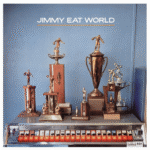
After 9/11, Jimmy Eat World replaced the title of their own album with the name of the band. Music magazines still write that they did it to stay off a song list circulated by the radio company Clear Channel. They were never on it.
There was a cardboard standee in Jim Adkins’ room, promo material for Bruce Springsteen’s album “Tunnel of Love”. “I think my seventh grade girlfriend gave it to me,” Adkins says. When he was sitting on the chorus of a song that still had no name, the standee came to mind. “Yeah, what would the Boss do? He’d probably say something like this. All right, I guess that’s the lyric now,” he tells Rolling Stone in an interview for the album’s anniversary. The line is “Everything, everything’ll be alright”.
The song became “The Middle”. What set it off was a message to the public band address Jimmy Eat World had been running since “Static Prevails”; a listener wrote that she was being put down at school. Adkins thought the result was the weakest thing he had. “At the time we wrote it, I didn’t think ‘The Middle’ was all that valuable because it was so simple and came together really quickly,” he told the US magazine SPIN in 2021. “We put it on the record but we never expected for it to have the connection with people that it has. I think there is definitely a fallacy as an artist where something you struggle with is of more value than one that is easy and just falls in your lap. ‘The Middle’ fell into our laps.” The song came out as a single in October 2001, reached No. 5 on the Billboard Hot 100 and topped the US modern rock chart.

By the time that chorus existed, the band no longer had a label.
What Capitol Added Up
Jim Adkins, Tom Linton, Rick Burch and Zach Lind come from Mesa, Arizona. Capitol signed them in 1995, straight out of high school, as GRAMMY.com sums up the prehistory. “Static Prevails” (1996) and “Clarity” (1999) followed. “Static Prevails” moved fewer than 10,000 copies in its first run; “Clarity” was quickly treated as a reference record inside the scene but stayed below Capitol’s expectations. What reach the band had in those years came mostly from “Lucky Denver Mint” on the soundtrack of the comedy “Never Been Kissed”.
August 1999 was the end of it. SPIN names that month explicitly and puts the drop down to the support that never came for “Clarity”. Two further sources, the US site The Ringer and the British Quietus, name a second reason: the label president and the A&R man who had signed the band were no longer in the house.
Adkins describes the process in Rolling Stone as what it was, an arithmetic operation: “Business affairs at Capitol just added it up and decided, ‘We can’t spend any more money on these guys.'” To SPIN he recalls the order of magnitude at stake: big labels knew exactly what to do with bands moving 20,000 records a week. “But they had no idea what to do with bands like us that sold 10,000 copies between all releases.” The number is his memory; there is no audited statement behind it.
Side Jobs, Tour Money, a Producer on Credit
What came next, the band paid for itself. The four of them worked on the side, in construction, at a car dealership, selling art supplies. They also ran their own European distribution: they bought copies of “Clarity” at wholesale prices from Capitol’s college department and shipped them to Germany, and 400 people showed up at their first gig in the country, GRAMMY.com reports. Two years later “Bleed American” entered the German album chart at No. 20, its peak there. No Jimmy Eat World single has ever charted in Germany, not even “The Middle”.
They put demos on Napster, which Adkins explains to SPIN without much drama: it was a way of getting the music to places where their records were hard to find. In August 2000 came the compilation “Singles”, a collection of B-sides and rarities whose proceeds went into recording the next album.
The sessions began in October 2000. Producer Mark Trombino, who had already handled both Capitol records, worked without a fee at first and waited for his money until it was clear whether any would arrive. Adkins sums up the funding model in one sentence: “We took all of our touring proceeds and put it towards making the record.”
The result was a finished, paid-for album with no contract attached – a product no major had to carry any development risk for.
Nine People, a $9,000 Bill
In spring 2001 came what the industry calls a bidding war. Manager John Silva set up meetings in New York, among them with RCA, Atlantic and Elektra. Zach Lind remembers the approach in MusicRadar: “I remember just flying into New York City, seeing the Manhattan skyline, the sun setting, and thinking, ‘Holy shit, this is crazy!'”
Adkins tells the British magazine Clash about a courtship dinner with RCA at an Italian restaurant. The manager spotted a rare bottle, the A&R man in charge kept it coming. “It ended up being a $9000 meal! They just kept bringing over this $300 bottle of wine and there were like 9 of us or 10 of us.” The band did not sign there. The scene is Adkins’ recollection, the other side does not get a word in it – as a picture of the cost structure of the business it works anyway.
In April 2001 the deal went to DreamWorks, with independent promotion, tour support and guaranteed video budgets; the value is reported to be in the seven figures, and the sources give up nothing beyond that. The cheque arrived with nothing to spare. “We were totally broke,” Lind says at MusicRadar. “When we got a cheque from DreamWorks after we signed, it was just in the nick of time. If that hadn’t happened, we would have been trying to figure something out, like maybe sell the house.” The second option he names is his wife going back to work.
Lay that sequence out side by side and a balance sheet is hard to avoid. A major ran the numbers on the band, lost its advocates inside its own building and let them go. The band produced, at its own expense, the album that would later reach two million certified units, sales and streams combined. A different major bought the finished result. What Capitol lost on this band and what DreamWorks made from it appears in no public annual report.
An Album That Lost Its Name
“Bleed American” came out on 24 July 2001 on DreamWorks. The start was solid, no more than that: No. 54 on the Billboard 200 in the chart week of 11 August 2001. Only a year later, in July 2002, did the record climb to No. 31 – by which point “The Middle” had long been running on MTV.
In between comes 9/11. Out of concern that the title might be misread in the new climate, the album was repressed under the band’s name from December 2001 on, and the title track ran as “Salt Sweat Sugar” from then on. In the UK the single appeared in November 2001 under the new name from the outset; to this day the Official Charts Company lists no UK single by the old name, only “Salt Sweat Sugar”. No recall of copies already shipped is documented; what changed was only what went to the pressing plants afterwards. It took the deluxe reissue at the end of April 2008 to restore the original title.
Who made the decision is not in dispute. “It’s sort of a complicated answer. The short answer is that it was our decision. We worked too hard on the material to keep people from ostensibly not being able to listen to it,” Adkins said in a 2021 interview with Consequence. To SPIN he adds that it happened almost at once: “It was almost immediately that we changed it. Just that threat of someone being offended … we decided, in the wake of the craziness and tragedy, we didn’t want to have something block people from objectively connecting with it.” The label went along with the decision. The band made it.
The List They Were Never On
On 14 September 2001 the radio company Clear Channel sent a list to more than 1,100 stations. The versions in circulation name 162 songs plus everything by Rage Against the Machine. It was not an instruction but a suggestion – tracks that stations might not want to play in those days. The list became public through the industry newsletter Hits Daily Double.
Jimmy Eat World were not on it. Three full lists published independently of one another – at Wikipedia, at Consequence and at Kerrang! – contain neither the band nor the album. The original document itself can no longer be inspected; whether the circulating versions match it exactly cannot be verified. Bruce Springsteen, the man from the cardboard standee, appears on all three lists with three titles, “I’m on Fire” among them. The song still goes by that name today.
A different version has stuck all the same. Stereogum wrote in 2021 that the band had been forced to rename the title track in order to circumvent its inclusion in the Clear Channel memo. Four years later the Quietus wrote the same thing. The claim shows up in more texts than those two. It fails on the dates alone: the memo went out on 14 September, the renaming happened in November and December. A change in December can neither prevent an entry from September nor undo it.
No order from outside was needed. A band that was on no list made the title of its just-released album disappear from the pressings because that was the climate.
A Genre the Band Never Wanted
2001 was the year emo came out of the basement. Dashboard Confessional released in March, Thursday in April, Jimmy Eat World in July. Writing in the Quietus, culture journalist Emma Garland has made the case that the three albums from “Static Prevails” to “Bleed American” are the definitive three-album run of that subculture, because they map its way out of suburban basements and into the industry in miniature. Garland also argues that the climate after 9/11 helped make emo one of the biggest youth cultures of the 2000s. She explicitly puts that forward as an argument, not as a finding.
The band itself has never had much use for the label. “We don’t really consider ourselves anything other than a rock band,” Zach Lind told the Irish News in 2019, calling the term “a little lazy”. That squares with what happens on the record: Adkins told GRAMMY.com he only really got Springsteen and the Everly Brothers after “Clarity” – simpler construction, simpler arrangements. So the genre’s commercial breakthrough ran through an album on which the band was busy dropping the vocabulary of Midwest emo. For Garland that is exactly what makes the run worth looking at.
Three European Dates, None on the Mainland
Jimmy Eat World have been touring the complete album since 9 June 2026, starting at Red Rocks Amphitheatre in Denver. Europe gets three dates, all of them in the UK: 14 August at the Piece Hall in Halifax, 15 August at Cardiff Castle, 16 August at the Crystal Palace Bowl in London. The London show had to be moved in May: according to the park, promoter Festival Republic pulled out of Gunnersbury Park, with a missing planning permission given as the official reason. On the European mainland there is not a single date. In June, Adkins described the tour to the Spokesman-Review as a one-off: “this is it. We’re not gonna do this again.” He means the full-album tour, not the end of the band.
On 6 September they play Chase Field in Phoenix, one city line away from Mesa, opening for My Chemical Romance. Gerard Way experienced the attacks from a commuter train heading into Manhattan; he has described several times how those hours brought him back to music. My Chemical Romance formed shortly afterwards.
“The Middle” is past 1.3 billion plays on Spotify (as of July 2026). On 24 July 2026, exactly 25 years after its release, the RIAA moved the album up from platinum to 2× platinum. Four songs from that era carry the same certification date. In the register the record appears under the name the band itself withdrew in December 2001.