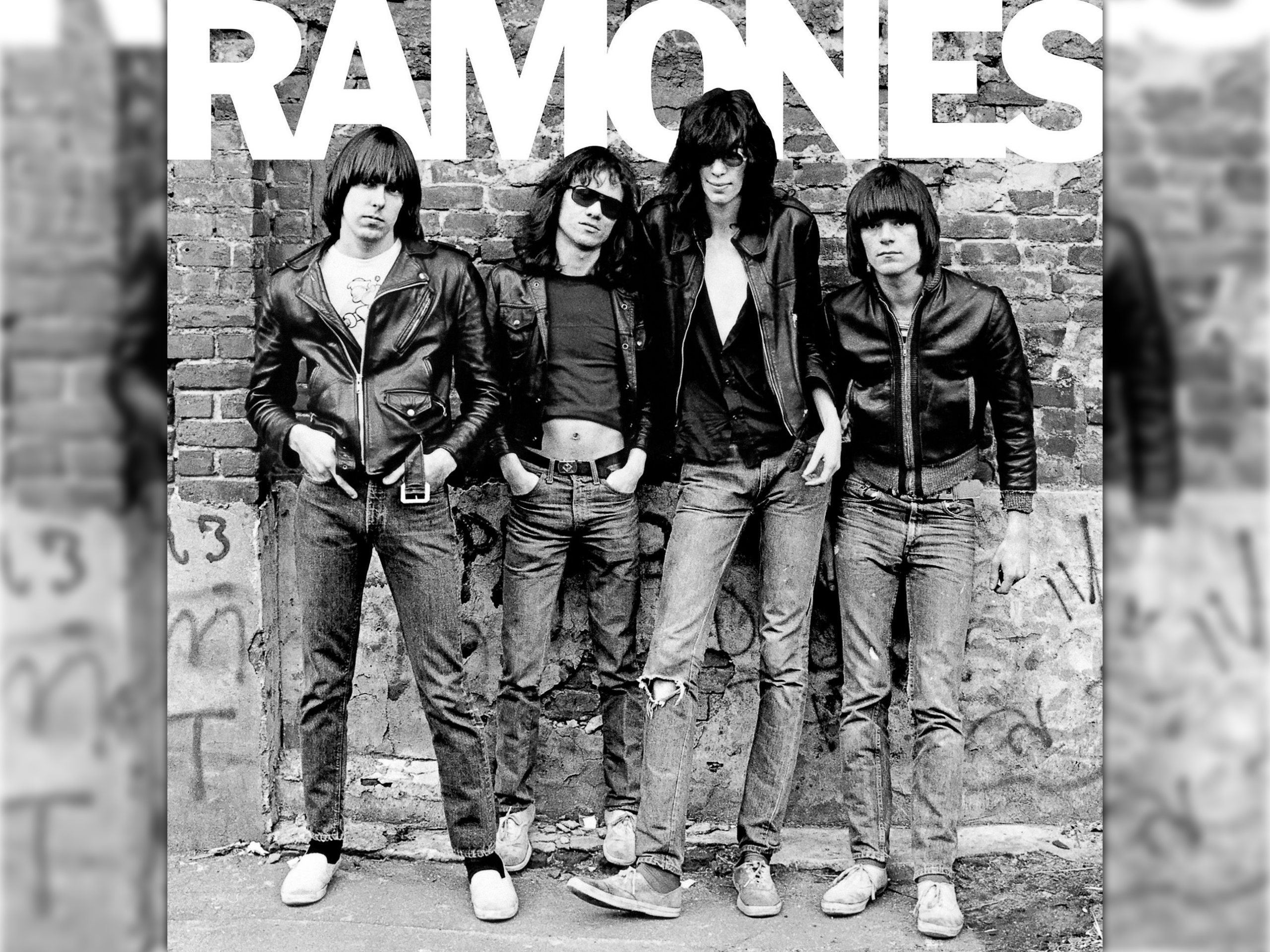
50 Years of the Ramones Debut
$6,400 and 29 Minutes: How the Ramones Destroyed Rock to Save It
Tommy Ramone was carrying a bag of groceries home when the battle cry came to him. “Hey! Ho! Let’s go!” – four syllables, stolen from the way Mick Jagger mangled “High, low, tipsy toe” on the Stones’ version of “Walking the Dog.” The band had always made fun of it. Tommy shaped it into a chant destined to echo through stadiums worldwide and dropped it into a song previously called “Animal Hop,” which Dee Dee renamed because he wanted to “Ramones-ize it.” The result was “Blitzkrieg Bop,” and it was intended as an homage to the Bay City Rollers. It became punk’s national anthem.
On April 23, 1976, the Ramones released their self-titled debut album on Sire Records. 14 songs. 29 minutes and 4 seconds. Recorded in seven nights for $6,400. Today, fifty years later, not a single founding member is still alive, but the record achieved something few albums manage: it shifted the coordinates by which rock music orients itself. Rolling Stone ranked it the greatest debut album of all time in 2022. The Library of Congress inducted it into the National Recording Registry in 2012 as “culturally, historically, and aesthetically significant.” It didn’t reach Gold status until 2014 – 38 years after release, when three of the four Ramones were already dead.
The story of this album can be told as a paradox: it sounds like someone hit record and let the band play. In reality, it was a precisely constructed studio work that elevated the illusion of rawness to an art form.

The Room Above Radio City
In early 1976, four men from Forest Hills, Queens, walked into a studio that had nothing to do with punk. Plaza Sound occupied the eighth floor of the Radio City Music Hall building, in a room that had once served as Arturo Toscanini’s rehearsal space. Art Deco interiors, a Wurlitzer pipe organ, a floor suspended on steel springs and cork – designed for orchestral recordings, not for four guys in leather jackets. Johnny’s guitar amp was set up in the Rockettes’ rehearsal room. The sound that would come to define punk was literally born where chorus dancers practiced their choreography.
The band arrived every evening after seven to take advantage of cheaper night rates, working until five in the morning. Two to three nights for the instruments, four for Joey’s vocals, one 14-hour marathon session for the mix. Tommy Ramone was sick on the first day; that day’s recordings had to be scrapped. There was no margin for error.
Producer Craig Leon, who also happened to be the A&R man who had discovered the Ramones at CBGB and brought them to Sire Records, knew exactly what he was doing. The common narrative of a raw, unprocessed punk sound is a myth. Leon placed a Shure SM57 right against the guitar cabinet and a Neumann U87 roughly six feet away for room ambience – orchestral microphone technique applied to a band playing at 170 BPM. He doubled Joey’s nasal voice using tape delay, a technique Ken Townsend had developed at Abbey Road Studios for John Lennon. He layered multiple guitar tracks until the sound of “Havana Affair” became what he himself called “a bomb going off.” He deliberately copied the stereo panning from Capitol Records’ Beatles mixes of 1964 and 1965: bass hard left, guitar hard right, drums and vocals centered. A technique considered outdated by 1976 standards – but one that produced exactly the visceral pressure Leon was after.
Tommy Ramone, credited as associate producer, summed it up in retrospect: “That record was really the sum of all our tastes: we liked eccentric music, we liked pop music, we liked very heavy music.” And then the sentence that nails the paradox: “It’s a lo-fi work of art.”
$6,400 Against Half a Million
To grasp what that budget meant, you need to know what was happening in rock music in 1976. Peter Frampton’s “Frampton Comes Alive!” – a double live album full of extended jams – was the best-selling album in America. Emerson, Lake and Palmer were touring with 35 tons of equipment and a piano that rose thirty feet into the air. Yes were releasing albums whose individual tracks ran longer than the entire Ramones debut. Production costs for major records ran up to $500,000.
Against that stood $6,400 – roughly $36,000 in today’s money. Less than a year’s rent in New York. Less than the price one of Johnny’s Mosrite guitars would fetch at auction in 2021. Sire Records had initially offered the band a single deal; the Ramones insisted on a full album. The compromise: studio costs would be deducted from their advance. Whatever was left would have to do.
It was enough for 14 songs that Johnny Ramone tracked in the exact order they’d been written – identical to the live setlist. The band had 30 to 35 songs in their repertoire. “We had the songs for the first three albums when we did the first one,” Johnny told Rolling Stone. He refused to do more than a few takes per song. A standard click track couldn’t keep up with the band’s tempo; Leon replaced it with a metronome that used flashing lights. And because the Ramones never ended songs live – they played their sets as one continuous blast – Leon had to teach them how to finish a track.
The Songs: Bubblegum and Abyss
The surface sounds like fun. The opener is a singalong chant inspired by a teen pop band. “I Wanna Be Your Boyfriend,” written by Tommy, features a 12-string guitar, glockenspiel, and tubular bells – instruments that seemed better suited to the Beach Boys than a punk record. “Let’s Dance” is a cover of a 1962 Chris Montez hit, complete with the studio’s Wurlitzer organ, played by Craig Leon himself.
Underneath lies something else entirely. “Beat on the Brat” was born when Joey witnessed a mother hitting her child with a baseball bat in the lobby of his apartment building in Forest Hills. “53rd & 3rd” is autobiographical in the most painful sense: Dee Dee, who had arrived in New York as a teenager from a broken home, processed his past as a hustler on the notorious corner in Midtown Manhattan. “Everything I write is autobiographical and written in a very real way,” he said. “I can’t even write.”
And then there’s “Today Your Love, Tomorrow the World,” the song that nearly cost them the album. Dee Dee, son of an American soldier and a German woman, raised in postwar Germany, wrote about Nazi memorabilia he’d found in the rubble as a child. The original lyric read: “I’m a Nazi, baby, I’m a Nazi, yes I am.” Sire boss Seymour Stein threatened to pull the track. The band changed the line to “I’m a shock trooper in a stupor, yes I am” – though Joey consistently sang the original version live, audible on the 1979 live album “It’s Alive.” The tension the song generated wasn’t calculated provocation. It was the product of a biography in which Dee Dee’s German childhood, Joey’s and Tommy’s Jewish identity, and America’s postwar repression overlapped. Tommy’s Jewish parents had survived the Holocaust in Hungary by being hidden by neighbors. The family fled in 1956 during the Hungarian Revolution.
“Now I Wanna Sniff Some Glue” consisted of four lines about teenage boredom and solvent abuse. Dee Dee commented dryly: “I hope no one thinks we really sniff glue. I stopped when I was eight.” The song directly inspired Mark Perry’s fanzine “Sniffin’ Glue,” one of the first punk fanzines ever published, with its debut issue appearing on July 13, 1976.
“Chain Saw,” the album’s fastest track at nearly 180 BPM, opened with a circular saw sound lifted from Tobe Hooper’s “The Texas Chain Saw Massacre” (1974). And Debbie Harry once claimed that “I Don’t Wanna Go Down to the Basement” was partly about the legendarily terrifying toilet at CBGB: “As kids, we never wanted to go down to the basement ‘cos it was so dark and scary. And that toilet was certainly very scary.”
Four minutes of bubblegum, 25 minutes of abyss. In 29 minutes, the album told more about 1970s America than most double albums of the era.
July 4, 1976: Punk Crosses the Atlantic
Just over two months after release, the Ramones played their first UK show. No screenwriter could have picked a better date: July 4, 1976, the 200th anniversary of the Declaration of Independence. The venue: the Roundhouse in Camden, a converted railway building from 1846–47 where Jimi Hendrix and the Doors had played before them. The Ramones opened for the Flamin’ Groovies, with the Stranglers as third on the bill. Around 2,000 people saw the show – the largest audience the band had ever played to. Back in New York, they’d been drawing about 150.
Joey, Johnny, Dee Dee, and Tommy tore through 14 songs plus three encores and handed out miniature baseball bats promoting “Blitzkrieg Bop.” Marc Bolan of T. Rex was invited onstage. The NME wrote that the band had “took over the hippy Roundhouse and reduced it to the hottest, sleaziest garage ever.”
One detail that has become part of the legend is wrong: the Sex Pistols and the Clash were not at the Roundhouse. Both bands were playing the Black Swan pub in Sheffield that same evening – the Sex Pistols headlining, the Clash performing their very first gig. But the following night, at the sold-out show at Dingwalls in Camden, they were in the front row: Johnny Rotten, Paul Simonon, Keith Levene, plus Rat Scabies, Captain Sensible, and Brian James of the Damned, Chrissie Hynde, and half of London’s nascent punk scene.
The impact was immediate and measurable. Captain Sensible recalled: “Everyone sped up after that Dingwalls gig. Everyone in the audience, you knew most of them.” Marco Pirroni: “The Ramones were the biggest influence. Suddenly it’s 1, 2, 3, 4, duh-duh-duh-duh-duh. Before that, everyone was quite different.” Within six months, audience members from those two shows had formed Siouxsie and the Banshees, Generation X, the Slits, X-Ray Spex, and the Adverts. The Damned made their debut on July 6, the day after the Dingwalls gig, at the 100 Club supporting the Sex Pistols. Joe Strummer put it this way: “If that Ramones record hadn’t existed, I don’t know that we could have built a scene here because it filled a vital gap.”
6,000 Buyers Who Started Bands
Commercially, the album was a disaster. Number 111 on the Billboard 200. 6,000 copies sold in the first year. Both singles – “Blitzkrieg Bop” and “I Wanna Be Your Boyfriend” – failed to chart. But Robert Christgau gave it an A in the Village Voice, calling it “clean the way the Dolls never were, sprightly the way the Velvets never were.” Creem Magazine declared it “the most radical album of the past six years.” And the NME called it “an object lesson in how to successfully record neanderthal hardrock.”
The contradiction between critical acclaim and absent sales isn’t a fluke. It’s the core of the story. Those 6,000 first-year buyers started a disproportionate number of bands. Donna Gaines, sociologist and author of the Ramones’ Rock and Roll Hall of Fame induction text, put it this way: “The Ramones democratized rock and roll, you didn’t need a fat contract, great looks, expensive clothes or the skills of Clapton.”
The RIAA Gold certification for 500,000 copies sold came on April 30, 2014. By then, Joey (lymphoma, April 15, 2001), Dee Dee (heroin overdose, June 5, 2002), and Johnny (prostate cancer, September 15, 2004) were already dead. Tommy Ramone, the last surviving founder, died just under two and a half months later, on July 11, 2014, of bile duct cancer. It remains the only Ramones studio album to ever achieve Gold status.
The $54 Guitar
There’s one detail that distills the whole story better than any analysis. Johnny’s guitar, a blue 1965 Mosrite Ventures II, was bought in January 1974 at Manny’s Music in New York for just over $54. He played it through a Marshall JMP running 100 watts with every knob set to ten, no effects, bridge pickup only. His technique was as radical as it was seemingly simple: all downstrokes across all six strings, full barre chords instead of power chords, at tempos no other guitarist could sustain. Ed Stasium, who engineered the Ramones from “Rocket to Russia” onward, said: “Johnny makes it sound simple, but I can’t do it, and I bet Eddie Van Halen can’t. Not for an hour!”
The cheapest guitar in the room, played with a technique more demanding than its reputation suggested. The album in a single sentence.
What Remains When Everyone Is Dead
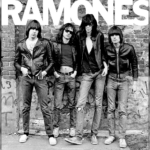
Fifty years after release, Roberta Bayley’s black-and-white photo of the four Ramones against a brick wall in Albert’s Garden – shot for $125 – hangs in the permanent collection of the Museum of Modern Art. Arturo Vega’s eagle logo, modeled after the Great Seal of the United States following a 1976 trip to Washington, with a baseball bat replacing the arrows and “Hey Ho Let’s Go” in place of “E Pluribus Unum,” adorns millions of T-shirts worn by people who have never heard a Ramones song. Vega attended all but two of the 2,263 shows the band played over 22 years. The Ramones sold more T-shirts than records. That, too, is a kind of legacy.
For the 50th anniversary, “All Good Cretins Go To Heaven: The Enduring Spirit Of The Ramones” by Jenn L. Beckwith – a 280-page retrospective featuring fan memories, band biographies, and concert stories – will be published on April 23, 2026. A multimedia touring exhibition presents photographs and art from CBGB to Berlin.
Patti Smith’s “Horses,” released in November 1975, had pushed the door ajar. The Ramones debut kicked it in. John Holmstrom, co-founder of Punk Magazine, had declared his intention to “wipe out the hippies and blow up the whole world of rock ‘n’ roll and start again.” 14 songs and 29 minutes later, the old rock was indeed blown apart – using studio equipment any professional could have operated, with Beatles-era techniques and orchestral miking, in service of a vision so focused it sounded simple and inevitable.
Joey Ramone knew what they’d achieved: “Doing an album in a week and bringing it in for $6,400 was unheard of – especially since it was an album that really changed the world.”
He was right. Not because the record was simple. But because it made simplicity into precision.