The house always wins
Gambling Sponsorship at Wacken Open Air 2026
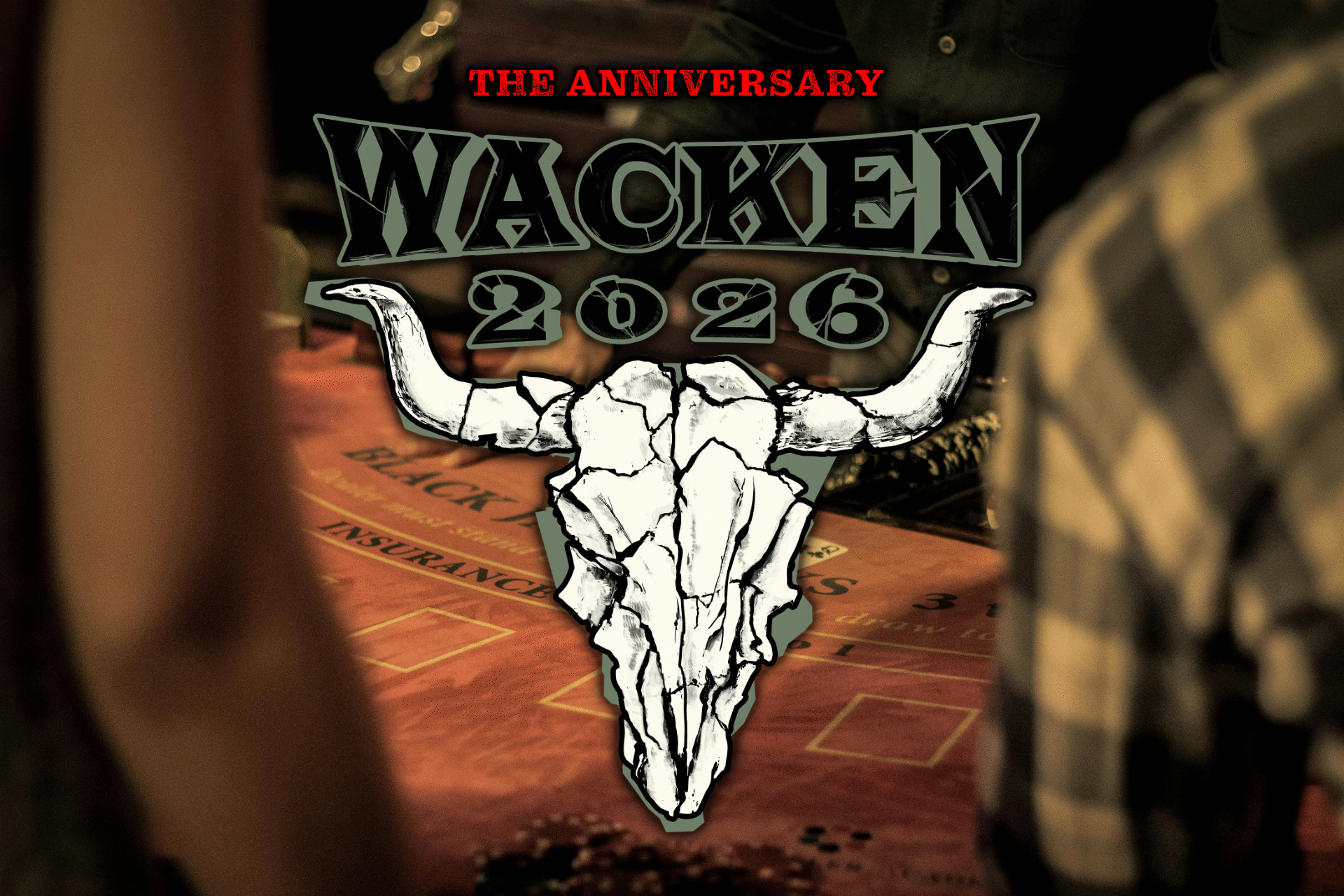
This year, a casino stands between the beer stand and the merch tent. What Wacken Open Air announced on Facebook as festival fun – “Zwischen Riffs, Moshpit und Festivalfeeling wartet auf euch das Casino Schleswig-Holstein” (“Amid riffs, mosh pit and festival feeling, Casino Schleswig-Holstein awaits you”) – turns out, on closer inspection, to be something else: the advertising campaign of a gambling operator, placed in the part of the festival that children are allowed to enter, open twelve hours a day, for a whole week. It runs while the state of Schleswig-Holstein is trying to sell its casinos by October, and while two of the world’s biggest financial investors have held stakes in the festival since 2024.
One Tent, Twelve Hours, Seven Days
The basic facts come from the official announcement: from 26 July to 1 August, daily from 10 a.m. to 10 p.m., visitors can “try” blackjack and roulette on the Camping Plaza, right in front of the Bullhead City entrance. The pop-up thus opens on the first arrival day – three days before the festival officially starts – and stays open through the entire camping week of up to 85,000 people.
The announcement leaves out the decisive points. Not a word on whether real money is involved. An age restriction appears only in the small print: “Admission from age 18 with valid ID” runs in narrow type along the bottom edge of the promotional tiles, next to a note that gambling can be addictive. Above it, in bold blackletter type, the slogan that reveals what the operation is for: “So spielt der Norden! In Kiel, Flensburg, Lübeck, Schenefeld und exklusiv auf dem Wacken Open Air” (roughly: “This is how the North plays! In Kiel, Flensburg, Lübeck, Schenefeld and exclusively at Wacken Open Air”). The tent is meant to bring customers into the four casinos where the games are played for real money.
Only after criticism piled up under the announcement did the festival follow up with a statement on its channels: it takes the concerns seriously, no money is being played for at the booth – “you’re not playing for money – there’s nothing to lose, only prizes to win”. Gambling, the statement went on, is legal and strictly regulated in Schleswig-Holstein, and other legal products carry risks too, alcohol and tobacco for instance. Alcohol, of all things: at a festival, it is not evidence that a casino tent is harmless, but one of the factors that increase gambling risk. And the statement’s most substantial piece of information sits in a subordinate clause. There are prizes to be won.
Anyone who wants to know what those prizes are gets little from the operator. Spielbank SH GmbH, the state-owned casino operator of Schleswig-Holstein, first left our inquiry of 18 July unanswered, declared five days later that it could not confirm receiving it – and, after we delivered the original email a second time, finally stated that the questions had been answered “comprehensively by the Interior Ministry” and that it does not comment on “contractual matters with business partners” (our translation, as with all German-language statements quoted in this article). The company itself answered none of our twelve questions; what only the operator can know – whether data is collected at the booth, whether trained player-protection staff are on site, how visibly intoxicated guests are handled – remains open. The Wacken festival stayed silent on two inquiries, even though its ticketing system had confirmed receipt of both emails. The answers came from the Interior Ministry in Kiel, the state authority that supervises the casinos and acts as gambling regulator.
Nothing to Lose, Advertising to Win
First, the ministry confirms what the festival had claimed: at the booth, “playing with real money is not possible”, the offerings run “solely for entertainment and promotional purposes”. Then comes a sentence that directly contradicts the festival’s communication: “Winnings, payouts or other benefits of monetary value are not awarded.” No winnings – at a booth publicly advertised with “only prizes to win”? We asked again and attached a screenshot of the post.
The reply arrived a few hours before this article was published, and it resolves the contradiction in its own way. The earlier statement, the ministry says, referred “exclusively to benefits of monetary value”. What is handed out are “exclusively low-value promotional giveaways”: items branded “CASINO Schleswig-Holstein”, each worth less than 13 euros – the ministry lists T-shirts, caps, sunglasses, sunscreen and power banks as examples. There are no vouchers or free plays for the casinos. Whether those would count as benefits of monetary value and change the regulatory assessment was therefore “not examined in the present case”.
No money, no free plays, just trinkets – that sounds like the all-clear. Except these trinkets are not nothing. They are advertising that distributes itself: whoever wins at the roulette table wins a piece of clothing with a casino logo and then wears it across the campground for days. Every winner becomes a walking billboard. And the slogan the festival used to promote the booth describes a world in which gambling has no losers – nothing to lose, only things to win. The regulator had that wording in front of it when it reviewed the concept. Asked whether it knew the festival’s communication, the ministry answers with a single word: “Yes.”
The Business Behind the Roulette Table
Casino Schleswig-Holstein is Spielbank SH GmbH with its four locations. At the festival, it shows off the elegant classics, blackjack and roulette, the James Bond image of gambling. Those exist in its houses too: all four locations offer poker and blackjack, three of them classic roulette; Flensburg lists only multi-roulette terminals. In day-to-day operations, though, the weight lies with the slot machines: in Kiel, 58 slot machines stand next to four roulette tables, and Flensburg advertises 70 machines “of the latest generation”.
That difference is not a detail. Germany’s national gambling survey 2023 (Glücksspiel-Survey) counts slot and casino games among the high-risk forms of gambling because of their rapid pace of play, and it puts numbers on what that means: 21.8 percent of those who play slot machines in casinos show a gambling disorder, for roulette it is 21.4 percent, for coin-operated machines in arcades and pubs as much as 25.5 percent. More than one in five players at a casino slot machine, in other words, is not an occasional guest but a person with a clinically measurable problem. Germany’s Federal Institute of Public Health puts it this way on its portal check-dein-spiel.de: a large share of slot-machine revenue comes from people addicted to gambling. It is the same portal the Wacken promotional tiles reference in their small print. Whoever advertises their houses on the Camping Plaza ends up advertising those machines as well – they just aren’t in the tent.
Advertising Where the Kids Are
Germany’s State Treaty on Gambling (Glücksspielstaatsvertrag, GlüStV) allows casinos to advertise and to sponsor. But it sets a condition that is remarkably hard to meet on a festival campground: advertising must not target minors, and minors must be excluded as recipients “as far as possible”.
Now, the Camping Plaza is not a sealed-off adults-only area. It sits in the campground – and under the festival’s own youth-protection rules, that is precisely where the youngest belong: children under six are not allowed into the infield, but they are allowed onto the camping grounds. Sixteen- and seventeen-year-olds must leave the festival grounds at midnight – for the campground, where the casino tent stands. A gambling advertising booth, open twelve hours a day, in exactly the area the festival’s youth-protection rules assign to minors: how that squares with the state treaty was a question for the organizer and the operator. The regulator’s answer is revealing – above all in what it leaves out.
Yes, the ministry says, legally the appearance is advertising within the meaning of Section 5 GlüStV, a special event subject to notification, whose concept was “reviewed without objection”. Whether that advertising is compatible with the treaty’s rule on minors in Section 5(2), the regulator does not assess. It points out that the event does not fall under the treaty’s definition of gambling in Section 3 – and “nevertheless” describes an access concept that goes far beyond the “18+” in the small print and has not been described publicly anywhere: the event area is “accessible exclusively through two controlled entrances”, the organizer’s security staff check the age of guests “with an evidently youthful appearance”, those of legal age receive an admission wristband – minors do not get in.
That is considerably more control than the announcement’s small print suggested. It is still only partly reliable. The checks hinge on an “evidently youthful appearance” – a judgment call at the entrance, in the middle of a crowd full of young faces. The organizer, whose security staff are supposed to enforce the concept, has not confirmed it despite two inquiries. And the advertising does not stop at the wristband: the caps and T-shirts with the casino logo that can be won inside travel out onto the campground – where, according to the youth-protection rules, the youngest are.
A State Enterprise in the Shop Window
What makes the operation delicate is its timing. The state of Schleswig-Holstein wants to get rid of its casinos: by October 2026, Spielbank SH GmbH is supposed to be sold, according to the roadmap of the state’s CDU-Green coalition; the intention to sell was published in the EU Official Journal in early 2025. The four houses reported a surplus of around 16 million euros for 2025 – the kind of figure that makes an asset easy to dress up for sale. The sale is contested. The SPD, once in favour itself, now warns against a dismantling of player-protection standards, and addiction expert Manfred Patzer-Bönig fears that “player protection will be scaled down to the necessary minimum”.
Against this backdrop, a pop-up casino at the world’s biggest metal festival invites a second reading: it opens up a young, solvent target group for the asset on sale, one that so far rarely found its way to Schenefeld or Flensburg. We asked the state whether the Wacken appearance is part of the sale preparations. The Finance Ministry says no: the presence at the festival is “an operational decision by the management” and has nothing to do with the intended sale. The Interior Ministry instead offers its own interpretation of the tent: a focus of the offering lies on “informing about the advantages of the regulated casino offering”; the goal is to steer players away from illegal offerings toward regulated ones and thereby ensure player protection. In this reading, the casino tent between the beer stand and the merch is not advertising but public education. In the state treaty, this figure is called channelling (“Kanalisierung”), and it is the gambling industry’s all-purpose argument: whoever advertises, protects. That an advertising booth at a festival mainly reaches people who don’t gamble at all yet does not figure in this calculation.
Who Owns the Village These Days
The casino partnership is not a slip, it is a pattern. In June, W:O:A announced the arrival of Anheuser-Busch: Bud becomes the exclusive beer partner through 2030 and takes over the famous beer pipeline – the festival founders describe the world’s biggest brewing group as an authentic partner that fits the character of the festival. Volkswagen Commercial Vehicles extended as mobility partner through 2028, including “activation areas” on the grounds. And now a gambling operator on the Camping Plaza.
The sponsorship push also falls in a year in which ticket sales stalled. Not until 22 July, one week before the festival, did W:O:A announce it was sold out – after eleven months on sale. Until the very end, the top category was available for 349 euros, a festival-made Instagram graphic at one point put remaining tickets at 55 percent, and in the comment sections fans argue over pricing and the line-up. A festival whose tickets used to be gone long before summer had to court the undecided into the final week this time. Sponsors who pay become all the more attractive.
To understand why the festival sounds like a marketing plan, you have to look at the shareholder list. Superstruct Entertainment has held a stake in organizer ICS since 2019. In June 2024, Providence Equity Partners sold Superstruct to US financial investor KKR; in October 2024, CVC joined – two of the world’s biggest private equity firms, and both explicitly name Wacken Open Air as part of their portfolio in their press releases. Internationally, a boycott movement is running against the new owners: at Barcelona’s Sónar festival, more than 70 artists signed an open boycott letter and 28 acts withdrew; at London’s Field Day, almost half the line-up cancelled. Spain’s culture minister Ernest Urtasun declared that a fund actively contributing to the illegal occupation of Palestine should play no role in the country’s cultural life. Almost none of this has registered with the German metal public so far. On the Holy Ground, the story of the village that becomes the metal capital of the world once a year still holds – while in the background, a portfolio is being optimized, and the village is now part of it.
Faites vos jeux
You can regard a casino tent at a festival as harmless fun, and for most visitors that is exactly what it will be. But that argument confuses the guest’s perspective with the operator’s. For the guest, it is a game between two bands. For Spielbank SH GmbH, it is precisely targeted customer acquisition shortly before its own sale; for the festival, it is one more sponsorship module in the portfolio of two financial investors. Both sides know exactly what they are doing – and the regulator even knew the advertising slogan and found nothing to object to. The house always wins, after all.