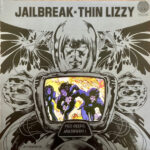
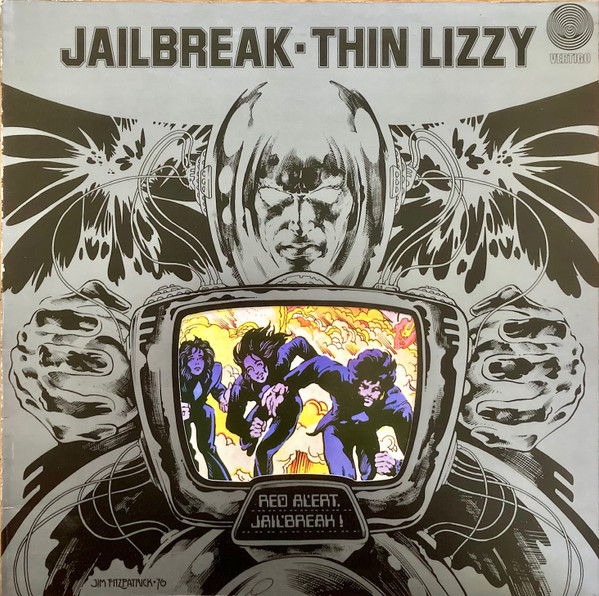
Rückblende – Thin Lizzy: Jailbreak at 50
How Two Guitars Learned to Speak with One Voice
Scott Gorham remembers the moment as an accident. A tape delay was running on the mixing desk when Brian Robertson was tracking a guitar line. The delayed signal layered itself over the original, and suddenly one guitar sounded like two. No plan, no concept. A technical error nobody corrected – because Phil Lynott immediately understood what he was hearing.
What grew from that accident over the following months changed rock music more lastingly than most albums that had set out to do exactly that.
Five Albums, No Breakthrough
Thin Lizzy were a band under pressure at the end of 1975. Five studio albums, not one had cracked the US charts. The label, Vertigo, gave them one last shot. Gorham put it plainly, years later: “We knew that three albums without a hit meant it was over – and the ball was coming straight at us.”

The band rented a farmhouse in Buckinghamshire, set up an eight-track recorder and wrote twenty songs. In December 1975 they moved into Ramport Studios in London. Producer John Alcock went for a dry, direct sound – Neumann U67 microphones on the guitar amps, barely any reverb, barely any effects. Every instrument had to stand on its own.
The Minor-Key Revolution
Harmonised guitars were nothing new in 1976. Wishbone Ash had established the concept from their debut in 1970 – on records like Argus (1972). The Allman Brothers did something similar. But both bands worked in major keys – warm, open harmonies rooted in folk and country.
Gorham and Robertson flipped the principle. Their harmonies sat in minor: fifths and thirds over dark root notes. “We’re operating in the minor area,” Gorham said. “That just hadn’t been done before.” What sounded sweet and floating with Wishbone Ash turned hard and urgent with Thin Lizzy. The sweetness was gone. The melody stayed.
Then there was a detail that sounds simple but is difficult to execute: synchronised vibrato. If one guitarist plays slow vibrato and the other plays fast, the sound tears apart. Gorham and Robertson matched their vibratos to each other until two instruments breathed as one.
The Song That Almost Didn’t Make the Album
“The Boys Are Back in Town” had no twin-guitar harmonies in its original form. The band didn’t even consider it single material. It was manager Chris O’Donnell who insisted it go on the album – the band had lost faith in their own judgement after five unsuccessful records.
The harmonies were added after the fact. They turned a solid rock song into something immediately recognisable: a riff that feels like a hug between friends walking out of the pub. The song reached number one in Ireland, number eight in the UK, number twelve in the US. It won the NME Award for best single of the year. It made Thin Lizzy famous.
And it drove Jailbreak to number 18 on the Billboard 200 – the band’s first and only gold certification in the United States.
A Black Irishman in Seventies Rock
Phil Lynott was an anomaly in 1976. Born in 1949 to an Irish mother and a Guyanese father, raised in Crumlin, a working-class neighbourhood in Dublin, as one of the very few Black children around. Illegitimate, dark-skinned, in an Ireland still firmly in the grip of Catholic orthodoxy – Lynott embodied everything that Irish society in the fifties and sixties would have preferred to suppress.
The Open University describes him as “a lightning bolt in a country that had simply never produced anyone like him: a Black rock star with style, poetry and global ambition.” Radio stations didn’t know how to categorise Thin Lizzy – when programmers saw the album cover, they asked: “Is this an R&B band?”
Lynott didn’t respond with explanations. He responded with songs. “Black Boys on the Corner” confronted stereotypes about Black men as early as 1972. “Half-Caste” told in 1975 of being too Black for one side and not Black enough for the other. And “Emerald”, the closing track on Jailbreak, relocated the struggle to the twelfth century – Irish resistance against the Normans, set to music as the most complex composition the band had recorded to that point.
Lynott needed no justification for his existence. He made it his material.
The Line That Never Broke
The influence of Jailbreak cannot be dismissed as vague inspiration. It can be traced through specific statements and specific riffs.
Iron Maiden: Steve Harris wanted two guitarists from the start. “I wanted twin guitars because I wanted melody and energy at the same time.” Harris names Wishbone Ash and Thin Lizzy as direct influences – Lynott additionally shaped his bass playing.
Metallica: James Hetfield said: “Thin Lizzy inspired a lot of Metallica’s guitar harmonies.” He called Lynott one of his “lyric gods”, alongside Tom Waits, Nick Cave and Leonard Cohen. Metallica’s version of “Whiskey in the Jar” on Garage Inc. is no obligation – it is a bow.
In Flames and the Gothenburg Sound: Jesper Strömblad founded In Flames with the stated goal of combining Iron Maiden’s melodic guitar style with the brutality of death metal. The line runs directly: Thin Lizzy’s minor harmonies travelled via Iron Maiden to Gothenburg and became the foundation of an entire subgenre.
Mastodon: The band covered “Emerald” – of all the tracks on Jailbreak – as a bonus track on their debut album Remission.
The chain extends further: Baroness, High on Fire, Judas Priest, Guns N’ Roses. The AV Club summed it up for the 50th anniversary: “Without Thin Lizzy there is no Judas Priest, no Iron Maiden, no Guns N’ Roses.”
What the Critics Missed in 1976
Robert Christgau called the songs “Springsteen castoffs” and Lynott’s lyrics “boring”. It was not the first time a critic had missed the moment – and it was not the last.
Fifty years later, Jailbreak sits at an aggregated critical score of 90 out of 100. AllMusic calls it “a truly extraordinary album”. The AV Club places it alongside Electric Ladyland, Highway to Hell and Street Survivors. Martin Popoff praises “Gorham and Robertson’s sharpest metal to date”.
The band itself wasn’t sure in 1976 whether the album was good enough. Robertson and Gorham felt the fast production had made the songs too rigid. Tony Iommi of Black Sabbath saw it differently: he told Gorham at an awards ceremony that the title track “Jailbreak” contained “his favourite riff of all time”.
A Farmhouse, Two Guitars, and a Principle
In that Buckinghamshire farmhouse, Thin Lizzy didn’t just prepare an album. They established a principle: two guitars harmonising in minor can sound harder than any single guitar – and more melodic than any keyboard.
That principle holds today. It holds at Iron Maiden in the Sportpaleis in Antwerp, at In Flames in Gothenburg’s Scandinavium, at Mastodon in smoky clubs in Atlanta. The technique is the same. The key is the same. The studio accident has long since hardened into method.
Phil Lynott died on 4 January 1986, aged 36. A bronze statue on Harry Street in Dublin remembers him – the man who, in a country not made for him, made music that was made for everyone.
Scott Gorham still plays.
This article is part of the series “Rückblende”, in which stagedive.net examines the album anniversaries of 2026 as nodes in an interconnected history of music.